Miracle Winter: A Practical Guide to Using This Playful Display Font Correctly
Selecting the right typeface is rarely just about aesthetics; it is a strategic decision that influences readability, brand perception, and overall user experience. When you encounter Miracle Winter, you are looking at a display font designed specifically for fun, playful, and whimsical contexts. It is not a standard workhorse typeface for body text, but rather a specialized tool for creating spectacle. Understanding its specific characteristics—particularly its PUA encoding and decorative swashes—is essential for designers, marketers, and content creators who want to leverage its potential without falling into common usability traps.
Understanding the Nature of Miracle Winter
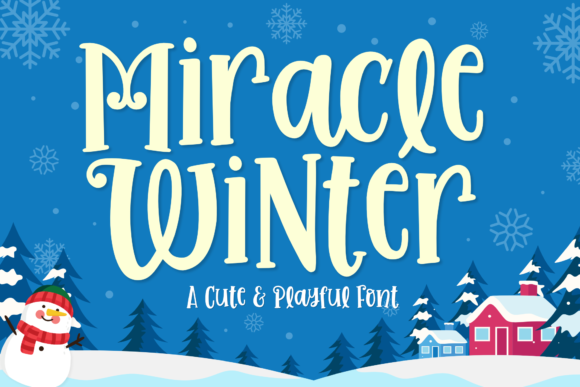
At first glance, Miracle Winter appears to be a festive or seasonal display font, characterized by its irregular, hand-drawn feel and decorative elements. However, describing it merely as "fun" undersells its utility in professional design. It is engineered to grab attention. The glyphs are constructed with a sense of movement and personality that standard sans-serifs or serifs simply cannot replicate. This makes it an excellent candidate for headers, posters, social media graphics, and packaging where visual impact is the primary goal.
The font’s ability to make ideas feel more realistic through its textured, almost tactile appearance is one of its strongest selling points. In a digital landscape saturated with clean, minimalist vector designs, a font like Miracle Winter offers a break from the monotony. It introduces warmth and approachability. For small business owners and hobbyists, this can translate to a brand identity that feels more human and less corporate. However, this strength is also its greatest weakness if misapplied.
The PUA Encoding Advantage
One technical detail that often goes unnoticed by beginners is the PUA (Private Use Area) encoding used in Miracle Winter. Standard Unicode fonts map characters to a fixed set of codes. PUA-encoded fonts, however, place additional glyphs, ligatures, and swashes in a reserved section of the character map that does not interfere with standard keyboard input. This means you have access to a vast library of decorative alternatives without cluttering your standard alphabet.
This feature allows for high customization. You can swap out a standard 'A' for a highly decorated version, or add intricate flourishes to the ends of words. While this offers creative freedom, it requires a different workflow than using standard fonts. Users must learn how to navigate their font software’s glyph panel to access these special characters effectively. Ignoring this aspect can lead to frustration, as typing normally will only yield the basic letters, leaving the spectacular swashes inaccessible.
Common Mistakes in Implementation
Even experienced designers occasionally misuse display fonts due to a lack of understanding regarding their limitations. Here are the most frequent errors associated with using Miracle Winter and similar PUA-encoded typefaces, along with strategies to avoid them.
Overuse in Body Copy
The most critical mistake is attempting to use Miracle Winter for paragraphs of text. Display fonts are designed for short bursts of information. Their irregular shapes, varying stroke weights, and decorative elements create visual noise when read in large quantities. This leads to cognitive fatigue for the reader, causing them to disengage from your message. If you use Miracle Winter for long-form blog posts or instructional manuals, you risk reducing comprehension and satisfaction.
Better Approach: Reserve Miracle Winter for headlines, titles, and key phrases. Pair it with a simple, highly readable sans-serif or serif font for body text. This contrast creates a clear hierarchy, guiding the eye naturally from the exciting headline down to the informative content.
Neglecting Contrast and Legibility
Because Miracle Winter is playful, it often features complex internal details. Placing this font over busy backgrounds, gradients, or images with low contrast can render the text illegible. Many users assume that because the font is "bold" visually, it will stand out on any background. This is false. Without sufficient contrast, the decorative swashes blend into the background, turning your design into a muddy mess.
Better Approach: Always test your typography against its intended background. Use solid colors or heavily blurred images behind Miracle Winter text. Ensure there is a significant difference between the font color and the background color. Adding a subtle drop shadow or outline can also help separate the text from complex visuals, enhancing readability without sacrificing style.
Ignoring Spacing and Kerning
Display fonts require more generous spacing than standard text fonts. The decorative elements often extend beyond the typical bounding box of a letter. If you set line height too tight or track (letter-spacing) too narrowly, the swashes will collide, creating an unintentional and messy appearance. This is particularly true with PUA-encoded fonts, where the extra glyphs may have wider side bearings.
Better Approach: Increase your leading (line height) by 10–20% compared to your body text. Experiment with tracking to give each character room to breathe. When using swashes, ensure they do not overlap with adjacent letters unless that is a deliberate stylistic choice. Manual kerning adjustments may be necessary for optimal results.
Evaluating Suitability for Your Project
Before downloading or purchasing Miracle Winter, consider the context of your project. Is the tone lighthearted? Is the audience expecting creativity and flair? If your project involves legal documents, medical instructions, or serious financial reports, Miracle Winter is likely inappropriate. Its playful nature undermines authority and seriousness.
- Good Use Cases: Holiday marketing campaigns, children’s book covers, party invitations, artisanal product packaging, social media banners, and creative portfolio headers.
- Poor Use Cases: Technical documentation, academic papers, navigation menus, and data-heavy infographics.
Additionally, verify the licensing terms. Some PUA-encoded fonts come with restrictions on commercial use or embedding. Ensure you have the right license to avoid legal issues later. Check if the font includes all necessary weights and styles, or if you need to purchase additional bundles to complete your design system.
Maximizing Efficiency with PUA Glyphs
To truly benefit from Miracle Winter’s PUA encoding, integrate it into your workflow efficiently. Most modern design software, such as Adobe Illustrator or Photoshop, has a glyph panel that allows you to browse and insert special characters directly. Take time to explore this panel before starting your design. Identify which swashes complement your layout and which ones might be too distracting.
Creating a "style sheet" for your project can save time. Define which headline sizes use Miracle Winter, which swashes are approved for use, and what pairing fonts are acceptable. This consistency ensures that your designs remain cohesive, even when leveraging the font’s playful variations. For freelancers and agencies, this discipline prevents last-minute scrambling and ensures a professional finish.
Conclusion on Strategic Application
Miracle Winter is a powerful asset for any designer’s toolkit, provided it is used with intention. It is not a replacement for foundational typography but a supplement for moments that require extra flair. By avoiding common pitfalls like overuse, poor contrast, and neglecting spacing, you can create designs that are not only visually spectacular but also effective and professional. Remember that the goal of any font choice is communication. Let Miracle Winter enhance your message, not obscure it.
When evaluating new fonts, always prioritize function alongside form. Test your choices in real-world scenarios. Ask yourself if the font supports the brand voice and enhances user experience. With careful consideration and practical application, Miracle Winter can elevate your projects from ordinary to extraordinary, delivering the realistic and engaging visuals that modern audiences expect.